
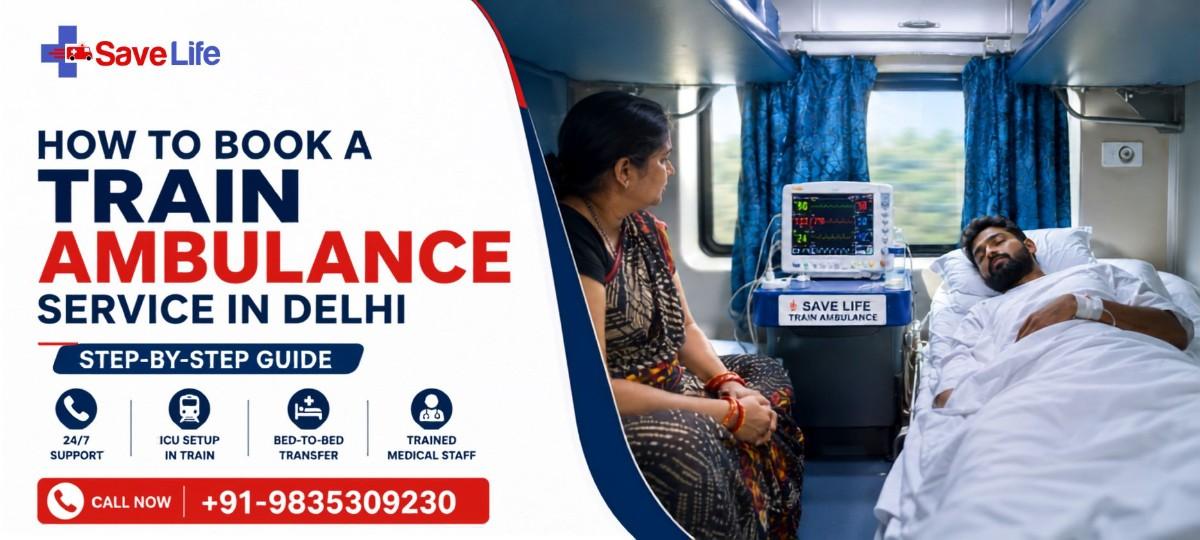
When a loved one needs to travel hundreds of kilometres for treatment, and their condition doesn't allow a flight or a long road trip, a train ambulance is often the safest middle ground. But if you've never arranged one before, the process can feel confusing — starting with the fact that most families don't even know what a "train ambulance" actually is.
If you're in Delhi or NCR right now trying to arrange one, here's exactly how the process works, which railway station to book from, what documents you'll need, and how long it takes.
This is the part almost nobody explains clearly: a train ambulance is not a government-run medical service, and there's no special "ambulance" category on IRCTC. What actually happens is simpler than it sounds — a private medical transport company books a normal AC berth (usually 2nd AC or 1st AC) on an ordinary passenger train, and then brings its own doctor, paramedic, and portable ICU equipment on board with the patient.
In other words, the train itself runs exactly as scheduled for every other passenger. What makes it a "train ambulance" is the private medical team and equipment layered on top of that berth — not any special arrangement with Indian Railways. Typically, four seats are reserved in the same coupe: one for the patient, one for the doctor, one for a paramedic or nurse, and one for a family attendant.
Once you know this, the rest of the process makes a lot more sense.
The process starts with a phone call to a train ambulance provider. Be ready to describe the patient's current condition, the hospital they're in, and where they need to go. Most providers assign a single case manager to your call so you're not repeating the same information to multiple people.
Before anything is booked, a reasonable provider will have a doctor review the case. Train ambulances work well for patients who are medically stable but need continuous monitoring — post-surgical cases, stable cardiac patients, stroke recovery, cancer patients in palliative care, and orthopaedic transfers. If the patient is highly unstable or deteriorating quickly, an air ambulance is usually the safer call, even though it costs several times more.
This is the step most guides skip — and it matters more than people realise, because Delhi has multiple major stations, each serving different routes:
👉 Swipe left to see full comparison
| Delhi Station | Best For | Notes |
|---|---|---|
| New Delhi Railway Station (NDLS) | Patna, Mumbai, Kolkata, Bangalore | Main hub for Rajdhani-class trains; closest to Central and South Delhi hospitals |
| Hazrat Nizamuddin (NZM) | Vellore, Chennai, Hyderabad, Bangalore | Main departure point for South India routes |
| Anand Vihar Terminal (ANVT) | Guwahati, Patna (eastern corridor), Kolkata | Best for East Delhi and Noida patients |
| Delhi Sarai Rohilla (DEE) | Rajasthan and western routes | Used for select western India connections |
If you're not sure which one applies to your route, this is exactly the kind of question to ask the provider on your first call — a good one will already know the fastest train option without you having to research it yourself.
Having these ready before you call speeds everything up considerably:
A transparent provider will give you an itemised cost breakdown covering the train ticket/coupe reservation, medical equipment, staff fees, and ambulance transfer at both ends — before you pay anything. Be cautious of anyone who won't put a number on this until after you've committed.
On the day of travel, a road ambulance collects the patient from their current Delhi hospital and takes them to the chosen railway station. The medical team typically arrives well ahead of departure to set up equipment in the coupe before boarding begins.
Throughout the journey, the accompanying doctor and paramedic monitor vitals, manage medication schedules, and handle anything that comes up en route. Family members can usually travel in the same coupe.
At the destination station, a second road ambulance is arranged to take the patient directly to the receiving hospital — ideally a genuine bed-to-bed handover, with no gaps where the patient is left without medical supervision.
This varies by provider, but a realistic range for Delhi is 12 to 24 hours from your first call to a confirmed booking, since it depends on berth availability on the right train. Providers who claim they can confirm in under an hour are usually being optimistic about railway seat availability — treat very short timelines with a healthy dose of scepticism.
Costs depend heavily on distance, the level of medical equipment required, and whether one or two medical staff are needed onboard. As a rough sense of scale, short routes like Delhi–Patna tend to sit at the lower end, while longer routes such as Delhi–Bangalore or Delhi–Vellore cost more due to longer staff engagement and travel time. For a full route-by-route price breakdown from Delhi, see our detailed Delhi train ambulance pricing guide.
A: No. The train ticket is a standard IRCTC booking. The medical team, equipment, and coordination are arranged privately by the ambulance provider — not by Indian Railways.
A: It depends on the destination city, not just your current location — a good provider will pick the fastest available train and tell you which station that puts you at. Anand Vihar is often convenient for East Delhi and Noida patients heading east, but this isn't a fixed rule.
A: Yes, typically one or two attendants can be booked in the same coupe alongside the patient and medical staff.
A: This doesn't change the process — the road ambulance simply starts its pickup from the NCR hospital instead of a Delhi one, then follows the same route to whichever station suits the destination.
A: As early as possible once the treating doctor has cleared the patient for travel. Even in genuine emergencies, most providers can still arrange something within a day, but earlier calls give you more train and berth options.
If you're coordinating a transfer from a hospital in Delhi, Noida, or Gurgaon, Save Life Wellness operates from all major Delhi stations with a full ICU setup on board. Call +91-9031200544 for a free medical assessment — day or night.